The Hidden Risks of Cleaning Up After a Crisis
Following a traumatic event, a severe accident, or an unexpected passing at a property, the initial instinct for many homeowners or landlords is to grab a bucket, bleach, and a mop to restore order. However, treating a scene contaminated with blood or bodily fluids like a standard household spill is incredibly dangerous. In Round Rock, understanding the difference between conventional cleaning and professional remediation can save you from severe health risks and expensive secondary property damage.
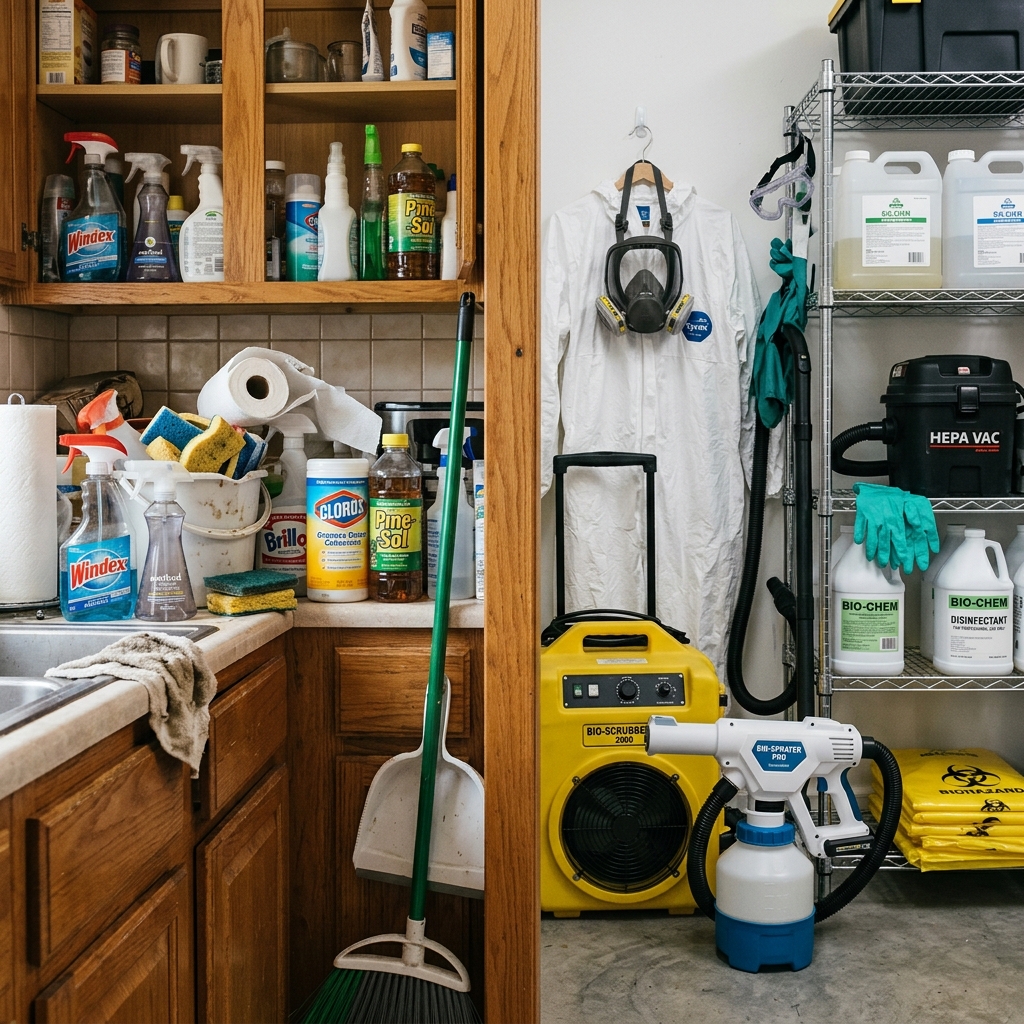
Professional biohazard remediation is vastly safer than DIY cleaning because it utilizes specialized PPE, hospital-grade disinfectants, and strict containment protocols to eradicate bloodborne pathogens. DIY efforts usually rely on inadequate household cleaners and risk pushing invisible contaminants deeper into porous materials, leading to lingering odors and severe health hazards.
The distinction lies in the microscopic risks. Biological fluids can carry invisible pathogens such as Hepatitis B, Hepatitis C, and HIV. Addressing these hazards requires specific training, chemistry, and equipment that cannot be purchased at a local hardware store.
Household Cleaners vs. Professional Disinfectants
When attempting a DIY cleanup, most people reach for bleach or ammonia. While these are strong chemicals, they are often used incorrectly. Bleach requires a specific dilution ratio and a designated "dwell time" (the amount of time it must remain wet on a surface) to actually kill pathogens. Even then, bleach does not dissolve biological proteins effectively; it often just bleaches the stain white while the biological matter remains.
Our Central Texas remediation specialists use professional-grade, EPA-registered disinfectants and enzymatic cleaners specifically formulated to break down cellular walls and destroy bloodborne pathogens. We understand exactly how different chemicals interact with various surfaces—from hardwood floors in older Round Rock homes to commercial tiles in medical offices.
The Danger of Cross-Contamination
One of the most significant failures of DIY cleaning is cross-contamination. If you use a mop on a blood spill in a bedroom and then carry that dripping mop through the hallway to the bathroom to rinse it, you have just contaminated the hallway and the bathroom sink. Foot traffic from well-meaning family members can also track invisible pathogens throughout the entire house.
If a biohazard event occurs, restrict all access to the affected room immediately. Keep pets and children far away, and do not attempt to cover the spill with towels, as this simply creates more hazardous waste.
Professional teams prevent this by establishing strict containment zones. We use thick plastic barriers and localized negative air pressure to isolate the affected room. Technicians wear full-body Personal Protective Equipment (PPE) that is safely removed before stepping into the "clean" zones of your home.
The Problem with Porous Surfaces
Perhaps the most costly DIY mistake is attempting to scrub porous materials. If blood or decomposition fluids spill onto carpet, the liquid passes immediately through the fibers, saturates the foam padding beneath, and pools on the wooden subfloor. Scrubbing the top of the carpet only pushes the fluids deeper.
Weeks later, as the Central Texas heat rises, the trapped biological matter will begin to decay, resulting in an overpowering, inescapable odor. Professional remediation involves the strategic removal of these unsalvageable porous materials, ensuring that the actual source of the odor and bacteria is entirely eradicated.
Liability and Regulated Waste Disposal
Finally, there is the issue of waste. You cannot legally or safely throw blood-soaked rags, contaminated carpet, or biological waste into a standard municipal trash can in Williamson County. Doing so exposes sanitation workers to severe health risks and opens the property owner to significant liability.
Professional cleanup support in Williamson County ensures that all biohazardous materials are properly packaged in approved, leak-proof containers, manifested, and transported to licensed medical waste facilities for safe destruction. By choosing professionals, you protect yourself legally, financially, and physically.